improv chant (that makes community)

This is the third post on Music that Makes Community XX.  

Today, I want to explore an unlikely equation.

Lectio Divina + ancient chant + Scary Improv = a stunning way to sing psalms.

As a priest, I have always found psalms tricky.  I love Anglican Chant, and am thankful that there are places (not too far from here) that do it well.  I love plainsong, and have had fabulous experiences of small groups of people singing Compline in dark country churches.  But often, congregations set out to sing psalms in ways that just don’t work.  I’m not sure, yet, how well what I’m about to describe would work in most churches.  It would certainly take courage to try. But we can do courage, right?  For a liturgy that shimmers, it is worth it, yes?

So, on we go.

Scary Improv Psalm began simply enough.  We were invited to say together Psalm 23 — in the authorized version (which I suspect was meant to be reassuring).  In fact, this was verbal mirroring, another form of the morning improv.  The leader began, and we matched his rhythms. As we went on, leadership moved around: other voices, other rhythm emerged. Sometimes there were ‘mistakes’ — words multiplied as memory took over and we slipped into alternate versions. Then, we would come together again, speaking as one.

At first, it was our mistakes that ornamented the psalm:  an embellishment here, a collective swirl and pause there as we found our way together.  Then we were invited past accident, into deliberate action.  This is where Lectio comes in.  In the same way that you ‘listen for a word’ in Lectio, we were invited to listen for the words that spoke most deeply to us.  To listen, as the leader spoke — and then to echo the words that jumped out.

The Lord is my shepherd
Lord
Lord
Shepherd
Lord

I shall not want
want
want

He maketh me to lie down in green pastures

lie down
lie down
…….pastures
maketh me

He restoreth my soul.

And on we went.  At first it was forced: deliberate echoing.  Hesitancy.  Then, we fell into prayer. Words rose and fell — awe-filled, reserved, angry, fearful, weary, hopeful.  Sometimes, stripped of emotion: pure word.  It seemed that many of us were equally lost in our own prayers and wholly caught up in the group.  The energy rose and spines tingled.  Yet all we were doing was speaking a psalm…

When we were done and had spoken about what happened, we were invited to do it again — this time singing.

The leader began to chant the psalm — neither Anglican Chant nor plainsong. The chant seemed to owe as much to the mosque as the church, and yet it was also born in the moment.  Notes came as the leader prayed.  We were asked to join in: echoing the words that spoke to us, illuminating the text.

Before we had started, we had been given a drone: a note held as a  ‘home base’, which offered both safety and energy.  For me it was mannna. I could not imagine making up melodic lines or harmonies — though in fact, I’d had to do that earlier, in Most Scary of Improvs — but it is possible to sing back a note, to echo a word just offered.  (Really, it is.)

For much of the psalm, that is all I did.  I echoed the occasional word, on the drone, probably inaudible to all but my nearest neighbour. Then — it should not have surprised me really — what was happening in the group became more engaging than my fear.  I began to hear patterns:  there was a woman behind me with a lovely light soprano voice who embellished the text with fine filigree of gold. There was a man near by who rumbled out of the depths of the earth.  There was someone who echoed in thirds, and another who multiplied the chant with rhythmic repetitions.  It began to make sense, and I started to hear where I could fit in.

The different voices helped me find my own.  The power of the psalm and the unity of the group deepened as each person found a way to be themselves.

How many times have I said something like that?  written it?  read it in a church profile? “We find our voice as we listen to each other.”  But never had I seen the concept come so vividly to life.  Music that Makes Community also makes very good theology.

And I have I mentioned, yet, that it was also great fun?

Next post: leadership.
This is a work of evangelism.  We are not done with this yet…
Scary Improv (that Makes Community)

[this post builds on the last — so you may want to start there if you missed it]

I’m going to leave the question of how the crowds at St Paul’s chapel responded to the all singing all dancing eucharist open for a while longer, so that I can tell you more about the Music That Makes Community workshop. (though honestly, what more can we say, after Mother Ruth’s ‘eeek’?)

My own ‘eeek’ came when the detailed schedule arrived a few days before the conference, and almost all of Friday was given over to Improvisation and Composition.  I am stunningly bad at improv.  As a teenager, the theatre director made a virtue of a hangup, and made me the stage-manager for the Improv Company.  They said and did funny thing spontaneously.  I muttered curses, as they skipped whole chunks of narrative, and frantically re-jigged light cues.  I can happily adapt a sermon, or weave something unexpected into a liturgy — but pure naked improv? no.

As for composing… well, you can imagine.  So much for learning a few new songs.

But it was a most remarkable day.  Bit by bit, barriers were broken down — flung up again — then once more dismantled.  We began with physical improv:  a mirroring game.  Not too hard, not too scary, though even then I preferred following to leading.  ‘Now add sounds’ made me flinch.  I should have just said ‘Eeek’ and been done with it, but that’s the trouble I have with improv: even the obvious things slip away.

By the end of that first session, it was hard to know who was leading whom.  We worked in pairs — but in our collective creativity and panic, we stole from each other shamelessly.  Someone did something that ‘worked’ and others instinctively mimicked it, until sounds and movements were spiralling round the group, even as we focused intensely on our immediate partners.  Towards the end, even I began to move from panic to enjoyment.  Feeling what the group was doing changed things. It helped me get outside of my own self-consciousness to begin to act more spontaneously.  Don’t misunderstand:  I was still very glad when it was over.  But something had happened, and I wondered what would happen next.

That’s quite a good space to be in liturgy:  ‘something has happened.  I wonder what will happen next.’

What happened next was a psalm — and it took my breath away.  But that is the subject of tomorrow’s post.

flags, founders, and blessed floundering

This is the first of a set of posts on Music that Makes Community

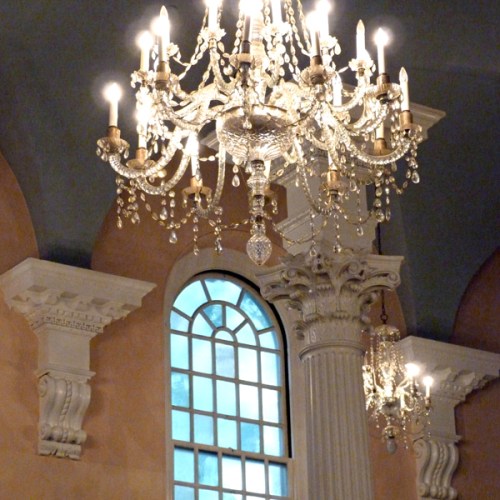
Overhead, light was dancing. Morning sun, and bright bulbs tossed by old crystal.
‘Just breathe…’ she said, willing us all to calm.
‘Breathe’ I repeated to myself, wishing I’d taken off my shoes.
Above: red, whilte & blue flags and crystal chandeliers. Beyond: George Washington’s plush chair, in an old box pew. Below: the rumble of trains– and of founding fathers, rolling in their graves.

Somehow I think the founders never planned on this: 40 people, stretched out on the floor: breath, then sigh. sigh, then hiss. hiss, then breath, then sing. But however strange it felt for me, St Paul’s Chapel had seen it all before: pews filled with sleeping firefighters, then pews giving way to beds. This was the place where the saints of New York slept as they searched for survivors, bodies, some tangible memory of those who were lost when the towers fell. So, a bit of morning warm-up was nothing, however odd it was for me.

I had gone to New York for a Music that Makes Community worship, run by All Saints Company. All Saints are probably better known in Britain as ‘the people who founded St Gregory of Nyssa’ or ‘you know: the crazy place that dances?’ I’d been reading about them for years, and finally it was my chance to see.

The idea behind Music that Makes Community is that community forms better when we are all able to participate fully — whether we read music or not, whether we grew up on the hymnal or have never been to church before in our lives. The idea, also, is that community forms better when we are willing to take risks: when the leaders and the congregation are dependent each other, when we create something together and trust the liturgy to hold the uncertainties that risk and creativity bring.

Now, you know I believe the theory. Indeed, a lot of the conference felt like an articulation of things I’d been working towards for many years. But I am as risk averse as the next person — and lying on the floor, hissing next to George Washington’s pew pushes me well out of my comfort zone.

But that was the point. For three days, we were pushed so far beyond what we thought we could (or would) do, that anything became possible. One woman said (after composing her first piece — a glorious riff on Marx, with a Christian addendum) “in the past two days, I have done so many things for the first time, I figured ‘why not?’ ”

‘Why not’ indeed.
But St Paul’s added another dimension. It’s one thing to ask a group of 40 people who have signed up for a music conference to sigh and hiss and sing. But what happens when that same group is imrovising a chant around the euchastic prayer — or being taught a call and response Hosanna — and passers by are invited to join in?

I want to write more about this over the next few weeks, but for now, I leave you with this question:

If you had come to St Paul’s to look at the 9/11 memorial — if you had come, perhaps, not even realising that it was ‘still a church’ — what would you do if you found an all singing, all dancing eucharist in your midst… and were asked to join in… and were shown the way how?