bing

Ah, social media.

It has been a big part of my life of late.  In part, it is a way of connecting.  In part it is a way of remembering how fickle I am (‘oh yes, I will start this.’, ‘look, I’ve started again!’, ‘… turning, turning, we come down right.’).  And in part, it is an attempt to use the time off I have this year to become more fluent with the forms of communication which are essential to ministry but which take time.

Learning to blog, or tweet, or use facebook takes no time at all, of course.  We proved that one year during lunch at synod (30 new tweeters, at your service).  Maintaining it and building it into something worthwhile is rather more demanding.

Twitter should be easier.  Fast and furious.  Funny and rewarding.  But how on earth do you keep up with it?

Every ten minutes or so, enough interesting links come through my twitter feed to keep me reading for an hour.  Many of these links are good — blog posts and articles written carefully by clever, engaged people.  But they come in helter-skelter, and I soon reach information overload.

And that’s the part that interests me, right now:  how quickly even good content on twitter turns my brain to mush.  I see university students constantly on their phones.  Twitter.  Facebook. Texts.  I do it too.  And I wonder:  how do they ever get anything done?  Do they ever spend 10 minutes uninterrupted?  Is it possible, now, to read for an hour?  To write for two?  To sit an exam for three?  Or do their neurons rebel if the constant ‘bing, bing, bing’ goes dormant?

I like social media, and I want to keep learning to use it better.  But it is a wild beast that I suspect will only be tamed by deliberate silence and withdrawal.

Or is this an introvert/ extrovert thing?  Readers: how do you do it?

Lent Blog 2012

For the first time in several years, the Lent Blog is happening.

These seasonal blogs have been such a fascinating journey.  They began very firmly within the Scottish Episcopal Church, written by clergy and laity from across the province, and with an official fanfare on the SEC web page.   A lot of the contributors had never blogged before.  Some had never really written before.  I spent a lot of time teaching people to use WordPress and saying ‘of course you can…’

Over the years, I had to spend less and less time teaching WordPress.  Now I am quite cavalier about it.  I simply say ‘If you need help call. Otherwise, happy blogging.’

Both the readers and writers have changed, too.  I still think of Beauty from Chaos and Love Blooms Bright as a vaguely SEC blogs — but the truth is that several of us now live in England, we are no longer even vaguely ‘official’, and a lot of our readership comes from the States.  I love that the blogs find their own home.  This sort of organic sharing feels far more expressive of the Anglican Communion than any conceivable covenant.

But one thing has remained constant.  I still spend a lot of time saying ‘of course you can.’  There has not been a single season when we haven’t had a new blogger on board — someone who was not quite sure whether they should be doing this, or what they might have to say.  Because we are blessed with a few very loyal and highly skilled authors and artists who provide the ballast, it has always felt easy to take the risk.    Sometimes people join in and find that really blogging is not for them.  Other times, they take wing and soar.  And that is exciting.

This Lent, the blog will be produced by familiar voices from the Advent Blog, by old friends returning, and by those I would never have met were it not for the blogs.

As always, I find great hope in that.  I hope you will join us too at Beauty from Chaos.

res miranda

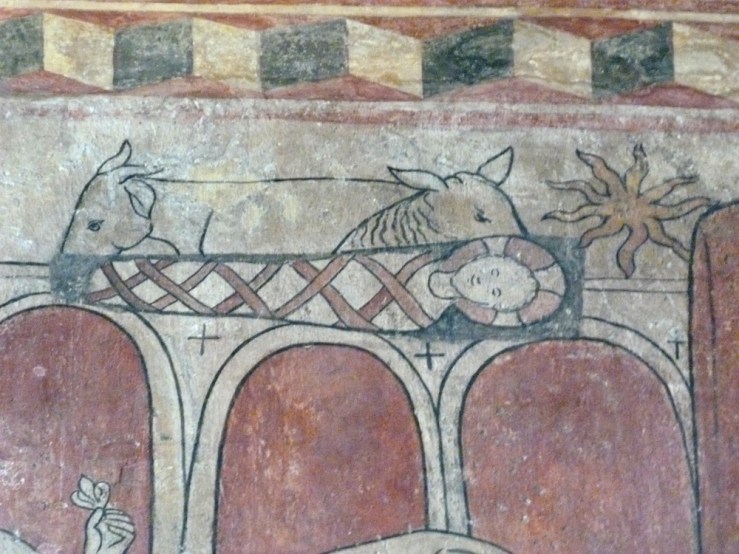
Gosh, it’s been a long time since we’ve had a good blog discussion.  The comments on the last post on the Easby Nativity are wonderful — and I still haven’t thought through half of them.  Kelvin seems to be leaning towards an essay on the influence of Eastern thought on Marian iconography.  Rosemary is exploring the economic situation of the holy family and the scarcity of donkeys.  Meanwhile Ruth keeps us grounded.
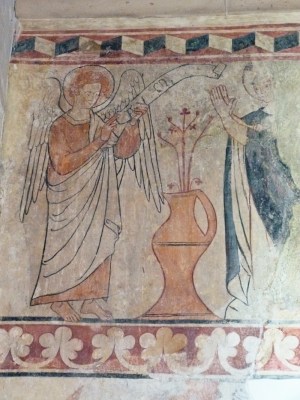
Inevitably, the essay I had in mind was about the incarnation and eucharistic theology (when is it not?).  The detail that fascinates me most in the mural is the hint of writing that threatens to cover the scene.  Other, now absent, writing did more damage to the Annunciation, and I wonder if the Reformers who whitewashed the murals used extra-nasty wash on the Marian scenes to try to ensure her demise.  Thankfully Mary is too tenacious for that, and we love her for it.

So, I find that these pictures help me understand the pain and turmoil of the Reformation in a way I never really have.  I’m no good at history, and care little whether something is in English or Latin, so the word-driven conflicts feel remote to me.  But when I stand in front of the Easby murals and think of them being blotted out and then covered with heavy words, I sense the anger of the masses who must have wanted their plucky Mary and weary Joseph back.

I wonder, too, how the paintings effected the congregation’s experience of the eucharist.  If every time you take bread and wine, the Christ child is smiling down at you from his ox-warmed crib, do you experience the paradox of Word made flesh, bread made flesh, flesh made Word more deeply?  Does it lead to a gentler, more hospitable Christianity than if you break bread and wine under the ominous Gothic script of The Law?  For me it would.

And for all that one might criticize the hierarchies of the Mediaeval church, I think there is something much more open-ended in telling the story of salvation through pictures instead of words.  Pictures tug at our hearts.  Quotations tell us that someone thinks they know just which bit of God’s word we most need to hear.

So, in the Curriculum of Wonder?  Well, this picture would keep us busy for a long time.  With younger children, we’d spend a few weeks with it at least (looking, naming what we saw, asking questions, learning songs, drawing pictures, imagining how it felt to see them covered over, trying to understand why someone would think it was right to do that, wondering how we can cope with people who upset us deeply).  With older teens, it might take a term, or a year.  I can imagine people picking a detail and trying to make sense of it; learning the history, exploring other images, talking with people about their sense of the nativity or the eucharist or the use of pictures in worship today.  And it seems to me that this is how we think now anyway — following links, exploring chains of ideas, letting something catch our eye and seeing where it leads us.   And then the teaching comes in trying to help each person put all the pieces together: to find some sort of cohesion and meaning in the midst of all the possibilities of wonder.  Teaching probably isn’t the right word.  It’s more ‘focusing’ — holding someone still long enough that they have time and space to think, and not letting them off the hook till they do.

Each panel of the mural tells a different story — it offers a different, overlapping curriculum.  I’m about to post them all up on Life and Light.  And today I give thanks for the vision of the artists who first pictured the smiling Christ-child, the brave Mary, the star-struck shepherds, and the insistent angels.  I am glad they got in quick with their water-colours before the plaster dried, and thus left us with visions of the glory of God that endured the worst of churchy conflicts and self-righteous violence.
really?

I am still thinking about what it would mean if we taught wonder rather than region.  But before I get there, I want to share something I stumbled across.

Yesterday, while thinking about potential changes to the ICT curriculum, I went hunting for information on what schools actually do.  I was asking myself the question: ‘how does RE work on the ground?’.  In other words, how does all of that promising vagary really translate in the classroom.  I found a website for a nearby school which had curriculum related links for students, parents and teachers.

Under ‘Christianity’ and ‘Christians’ it offered this:

Christian beliefs and traditions

Christian people believe

  • There is one God.
  • God made the world.
  • God has three parts – The Father, the Son and the Holy Spirit.
  • Jesus is God’s son.
  • When people die they go to heaven or hell.
  • God sent Jesus to the world to save people.
  • Jesus
    • was born at Christmas.
    • showed people how to live a good life.
    • died on a cross at Easter.
    • came alive again and went to heaven to live with God.

Now, you may think I’m about to have a go at that school’s RE curriculum.  I’m not.  I’m going to leave that to your imaginations, and to your comments.  No, no.  This is a failure of ICT.  Someone found a link and assumed it was reputable.  They trusted the nice people who provide resources for the hearing disabled, and forgot to ask whether they were equally conversant in Christian faith.

It’s a terribly difficult thing, teaching.  And it’s tricky, too, identifying the right resources.  So, I’m adding to my list.  Let us teach wonder and discernment instead of RE and ICT.  I’m sure I could make a course on wonder and discernment tick all the cross-curricular boxes. I’m willing to start tomorrow, so long as we can agree that there will be no exams, no red ink, and no end to the learning.