covenant

No, not that one.

The Methodist one.

I’ve been pouring through piles of liturgy books and re-reading the Methodist covenant service.  The covenant service is a peculiarly Methodist thing.  I realise that it covers much of the same landscape as my version of the Maundy Thursday Vigil  — i.e., what happens in the silence as I pray through the year, the people in the room, the people on my faith journey, and then move into that other space, harder to explain.  But that is rather idiosyncratic.

It is what we are supposed to be doing each time we gather for communion, each time we renew our baptismal vows, each time we get up in the morning.   But you see, that’s the genious of Methodism.  I have a profusion of images and ideas.  They have a nice orderly service to remind you of who you are.

The congregation is asked to pray:

I am no longer my own, but yours.
Your will, not mine, be done in all things,
wherever you may place me,
in all that I do
and in all that I may endure;
when there is work for me
and when there is none;
when I am troubled
and when I am at peace.
Your will be done
when I am valued
and when I am disregarded;
when I find fulfillment
and when it is lacking;
when I have all things,
and when I have nothing.
I willingly offer
all that I have and am
to serve you,
as and where you choose.

Glorious and blessed God,
Father, Son and Holy Spirit,
you are mine and I am yours.
May it be so for ever.
Let this covenant now made on earth
be fulfilled in heaven.  Amen.

The Methodist Worship Book, Covenant Service

Absolutely terrifying, isn’t it?

I suspect the ones who avoid the service and say ‘no’ might be the most honest.
But the ones who keep trying to mean it stand a better chance of it one day becoming true.
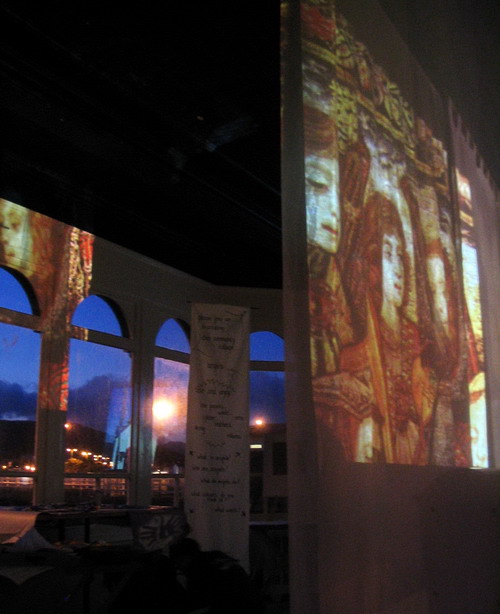
words & seasons

The lay team met for training today, having escaped having to do an assignment because of the complexity of schedules.  So, it was an on the spot task:  How does the liturgical year relate to preaching?

We started with a simple word-association game — writing down key words & themes for each season.  Then we shared what we had written, adding words, clarifying, questioning ‘why did you put that there?’

It was fascinating.  There was lots of overlap, as you would expect; but there were real differences too.  So, for example,  where would you put ‘Kingdom’ as a theme?  I put it in Advent:  already and not-yet, vision of a world transformed.  Isaiah, ox and lamb.  It’s there with themes of Justice, restoration, non-violence.

However, the group ‘forgot’ the justice theme for Advent, and had Kingdom listed just about everywhere else: under Christmas (Kingdom come), Easter (‘resurrection shows what the Kingdom is like’), Pentecost (‘living it out’) and the Green Season (on the theory that Christ the King ends the reign of green).  For the first time, I saw sense in naming November as ‘The Kingdom Season’.  At least it locks it down.

Lent came in heavy on penitence and cleansing, with a fair dose of journeying and introversion; but healing and forgiveness were curiously absent. When I said ‘Lent: healing’, someone argued that we had to wait for Easter for that.  She did not convince me; but in a few words, the difference in our theologies was clearly exposed.

It’s a game worth playing the next time you find yourself with a handful of piskies and a half an hour to spare. In the meantime, I offer you these for the seasonal sorting-hat:

  1. mystery
  2. humility-splendour
  3. pain-of-God
  4. eternity in time
  5. chocolate
  6. growth
  7. blinded by light
  8. humanness
  9. transformation
  10. ‘gloomy’  (surely not, I cried in horror.  Gloomy never goes with God.)

not me

A blissful morning of church without responsibility.

I have realised that on those rare occasions when I go to church somewhere else, what I want is in many cases the exact opposite of what I think matters as a priest.

So, I went early for quiet (a hoped for, but often unrealised goal in my various congregations).

I said a quick good-morning to the welcomer, and was impressed when he used as few words as possible to direct me to the second pew-sheet I missed.  (‘ you need… (point)’ ‘oh, thanks…’ and we both went on our way)

I said nothing to anyone after that.

The music was superb (and crucial to the experience of worship).
The sermon was tedious (which was frustrating, but didn’t matter nearly as much as I would tell myself it did if I had preached it).

As I left, the person ahead of me stopped to tell the rector about someone who had died, and I slipped past with a deliberate (simple) bow to show I wasn’t ignoring him, but no words.

I didn’t go to coffee (well, not at church) and I felt no need to linger.

Now, I know that that is not how I would behave if I lived there and were going every week.  But I was grateful for the freedom to come and go without being overwhelmed by people trying to make me welcome.

But if we in Cowal and Bute (or in our companion overseas diocese) let someone slip by so easily, would we think we had failed?