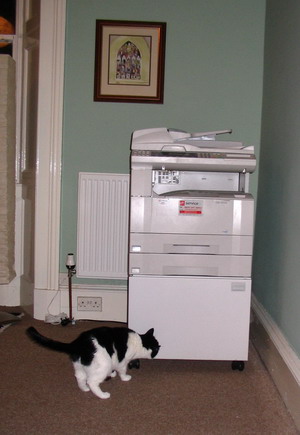
gained: one free photocopier.
lost: all pretense that I might one day have a splendid dining-room.
(and just in time for Thanksgiving too)
gained: one free photocopier.
lost: all pretense that I might one day have a splendid dining-room.
(and just in time for Thanksgiving too)
The lay team met for training today, having escaped having to do an assignment because of the complexity of schedules. So, it was an on the spot task: How does the liturgical year relate to preaching?
We started with a simple word-association game — writing down key words & themes for each season. Then we shared what we had written, adding words, clarifying, questioning ‘why did you put that there?’
It was fascinating. There was lots of overlap, as you would expect; but there were real differences too. So, for example, where would you put ‘Kingdom’ as a theme? I put it in Advent: already and not-yet, vision of a world transformed. Isaiah, ox and lamb. It’s there with themes of Justice, restoration, non-violence.
However, the group ‘forgot’ the justice theme for Advent, and had Kingdom listed just about everywhere else: under Christmas (Kingdom come), Easter (‘resurrection shows what the Kingdom is like’), Pentecost (‘living it out’) and the Green Season (on the theory that Christ the King ends the reign of green). For the first time, I saw sense in naming November as ‘The Kingdom Season’. At least it locks it down.
Lent came in heavy on penitence and cleansing, with a fair dose of journeying and introversion; but healing and forgiveness were curiously absent. When I said ‘Lent: healing’, someone argued that we had to wait for Easter for that. She did not convince me; but in a few words, the difference in our theologies was clearly exposed.
It’s a game worth playing the next time you find yourself with a handful of piskies and a half an hour to spare. In the meantime, I offer you these for the seasonal sorting-hat:
Found a new (to me) poet today. Thankfully didn’t notice it was a translation till I’d already bought it.
Interview with a Child
The master hasn’t been among us long.
That’s why he lurks in every corner.
he covers his face with his hands and peers through the gap.
Standing, forehead to the wall, he suddenly turns.The master rejects with distaste the absurd thought
that a table lost from view must remain a table,
that the chair behind his back stays within the boundaries of a chair
without even trying to take advantage of the situation.True, it’s hard to catch the world in its otherness.
The apple tree returns to the window before you can bat an eye.
The rainbow-colored sparrows always darken just in time.
The handle, the pitcher’s ear, will catch any murmur.
The nighttime closet feigns the passivity of the daytime closet.
The drawer tries to convince the master
that all that’s in there is what was put in earlier.
Even when a book of fairy tales is suddenly opened,
the princess always gets to her seat in the picture.They sense a newcomer in me — the master sighs —
they don’t want to let a stranger play with thtem.
But how come everything that exists
is forced to exist in only one way
in a miserable state, with no escape from itself,
without pause or change of pace? In the humble here-to-there?
A fly trapped in a fly? A mouse trapped in a mouse?
A dog never turned loose from its hidden chain?
A fire, without the nerve to do anything
but burn the master’s trusting finger a second time?
Is this the true ultimate world:
scattered wealth impossible to gather,
useless splendor, forbidden possibility?No! — the master shouts and stomps all the feet
he can muster — in such enormous despair,
that even the six legs of a cricket would not suffice.Wislawa Szymoborska, Miracle Fair
trans. Joanna Trzeciak
(you might think I should have noticed it was a translation,
but it was a rapid hunt before boarding a train.)
 wonderful exchange