All my favourite harvest hymns today — twice. And I will get to sing them again when it is Rothesay’s turn. Some one of these days I will have the nerve to remove Harvest Home form the pew sheet and let Maddy Prior sing it for us instead.
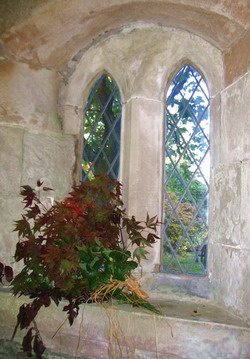
All my favourite harvest hymns today — twice. And I will get to sing them again when it is Rothesay’s turn. Some one of these days I will have the nerve to remove Harvest Home form the pew sheet and let Maddy Prior sing it for us instead.
The first Friday of my holidays began bright and early with school assembly. (yes, I know… but it was their last day of term.)
I talked about how we value things and why — building on the story of Anne Frank’s tree, which has had a sudden reprieve from the ax, while people look for ways to prop her up and kill the fungus that makes her a danger.
And by way of illustration I brought in three things for them to pass round:
The question was: what gives Anne Frank’s tree worth? Is it because of what it is, what it looks like, how it moves (the Tangle). Is it because of what it symbolizes — hope and beauty in the midst of one girl’s fear and darkness (the cross). Or is it because of the story we tell about it (the stone, given to me by a very dear old man in my ‘home’ congregation).
I hate the thought of that tree being propped up and held together and denied a peaceful death. Far better to let it go, and to act on the earlier plan of grafting a bit of it into new life, so a sign of hope remains. But I didn’t want to tell them that. They had to decide for themselves.
So I just told them how I felt about the stone. How it was the story that mattered. And how, once the story has worked its way inside us, the object isn’t so important — we can let go of it, or even give it away.
And you can see, now, where this is going, can’t you?
Let me tell you, giving a small hard stone to a 13 year old boy at 9am on a Friday morning is a pure act of faith.
And much to my surprise, no one told me off for it, and no one took it off him.
I wonder where it is now…
A few weeks ago, I was lucky enough to meet with three women testing a vocation to ordination in the Scottish Episcopal Church. All of the women were young, intelligent, and deeply committed to the church. One of them — the one furthest ‘down the line’ towards ordination — said to me, ‘do you believe that the church can grow, or is it inevitable that most congregations are shrinking and dying?’
Her question was passionate and urgent, and her relief palpable when I said ‘of course it can grow. It does grow. We have to believe that, and it is true.’ She and I have both seen congregations growing. It can happen. We know it is true.
But she had begun to fear because so many people claimed otherwise. So many people talk of the church’s failure, or try to bully their way into theological dominance by threatening the inevitability of the church’s demise unless we all choose to share their viewpoint.
The question of church growth is not ultimately about numbers or demographics or annual returns. It is about the shape of what we believe.
Do you believe that Christianity matters?
Do you believe it is true?
If we believe it matters and it is true, then we have to believe that the church can grow.
If we believe that it matters and it is true, then the church will grow, because the passion of our belief will communicate itself. The church will grow because it will be a place of God’s love and compassion and beauty, a place of healing where human life is redeemed.
If I did not believe this, I could not do what I do each day. I could not be a priest, and I doubt whether I could be a Christian.
What we believe matters.
If we believe that it is inevitable that congregations are shrinking and that the church must inevitably die, then it probably will. If we believe that God is irrelevant for most people and Christianity is nothing more than pastime for the curiously minded, then that too will become ‘true’– not because God is irrelevant, but because we will no longer be speaking of God in any meaningful way.
Congregations come and go. Buildings come and go. There is death and resurrection.
But if God is worth believing in, God is worth sharing. And that is all it takes for death to become life, for the church to be healthy and strong — and for young women testing their vocation to sleep well tonight, trusting in God’s future rather than the prophesies of doom.
More search string amusement. Today: ‘holy trinity for homework’.
As in ‘come to Holy Trinity: all the homework you could ever hope for’; ‘Hermione Granger always welcome here’.
ad maiorem dei gloriam
 wonderful exchange