the patience and humour of a friend who can bear me at my worst
And if you are populating your list of thanks for tonight, at least one of you might give thanks for the conference that spared you from answering the phone.
So tonight, foolishly, instead of going to bed or even finishing my book, I let a quick glance at last night’s Tony awards lead me to YouTube and Sondheim and Bernadette Peters.
What a strange childhood I remember. I never spoke much, as I recall (and my parents say I’ve been making up for it ever since). That meant that very little of what was going on in my head came out to the light of day to be noticed or commented on.
So I find myself wondering: would anyone have thought it odd that at 6, my favourite song was by Sondheim? (Send in the Clowns — the only one popular enough to get past mother’s screening, amidst all the Rogers and Hammerstein)
Next glance at Sondheim came at school: Side by Side by Sondheim — which offered in one evening a taste of a world opening up. My dominant memory? months of tension building between the soprano (who was used to being the star) and the alto (who knew she had more talent and the harder line) that was transformed into the performance of ‘A boy like that’ — hissing and spitting across the stage.
Then, it was time for Into the Woods.
I remember it distinctly. Mother and I went down to New York, as we were wont to do. We had orchestra seats, seven rows back to the right. ‘A sort of fairy tale’ she said — no doubt forgetting how dark fairy tales really are. And the curtain went up. I was nonplussed by the giant, then the witch arrived, and my world my never quite the same again.
I don’t remember liking the show, so much as being transfixed by it.
By her, really.
I had seen Bernadette Peters once before in Song and Dance — a show I hated and a character I disliked, with one wonderful song, and a performer who took my breath away despite the general dislike.
But with Into the Woods, it was different. Song and Dance bored me. Into the Woods bewildered me.
You must understand the context: my parents were undergraduates in the late forties and early fifties. My life was not far from a world that most of my contemporaries know only as farce: set hair and satin skirts, tea parties and layered finger sandwiches. Behind that rustled my grandmother’s memories of an Edwardian childhood, the flapper’s hopes, and the great depression.
Not the world of the Witch.
well, not officially, any way.
And into that world broke a voice of rebellion. Into that world came the permission to turn it all upside down. ‘Honour their mistakes, everybody makes, one another’s terrible mistakes. Witches can be right, giants can be good. You decide what’s right. You decide what’s good.’
Mother hated it. It’s the only time she threatened to walk out at intermission. But I feigned embarrassment, and forced her to stay.
Later that day, when I’d had time to process it and could draw breath again, I decided that she hadn’t understood it. Now, I realise that she probably understood it all too well.
Often in church, there is tension between what I expect of liturgy and what others seem to want. I don’t just mean here, in this congregation, but more generally. I blame it on the ‘Comfortable Words’ — a sense that the liturgy is there to soothe, to lap familiarly as water against the shore.
And I suppose I want that sometimes. But more often, I want the witch to come onto the stage and shatter my world. I want the words, the image, the space to see something that I have always known and never known before. I want catharsis, and healing, and a way to begin again. And always, always the promise: ‘You are not alone, truly not alone. No one is alone.’
And as I say it, I realise that Bernadette Peters is probably not a likely liturgical guide. Yet I suspect that a lot of my friends, a lot of the people who share my sense of church will ‘get it’ immediately — share the space I seek, even if choosing a different catalyst.
Bed time now, but I must give the witch the last word. Another song of formation for me. A sort of creed, that I am still working out. Pain and truth and hope and grace all at once — in the search for redemption.
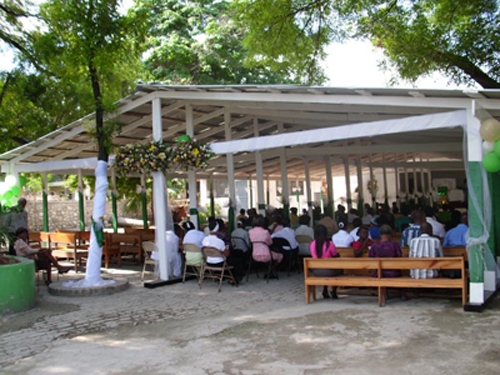
Sister Sarah has just shared this splendid photo of the ‘interim’ cathedral in Port-au-Prince. It’s good to see hope (and pews!) surviving.
It’s good timing too: the collection at the eucharist at General Synod is for St Margaret’s Convent in Haiti. Now, I don’t expect huge sums from the offering at the Synod Eucharist (given how often I’ve forgotten to have cash with me…) but at least it will make more people aware of what the sisters are doing there.
It is not as simple as finding it beautiful or liking the rhythms of it.
And for me, place is important. In ways that I cannot explain, I become more myself in certain places. Of course that is about learned association, relationships, memories; but it is also in the stones.
When I was first ordained, I thought that the dream of the church would suffice. I had a view of priesthood that was no doubt rooted in my (Roman) Catholic childhood: you go where you’re sent. You go where you’re needed. Having chosen the wider geography (Scotland) the details didn’t matter.
But I was wrong. Dunoon taught me that. I had interesting, creative, growing congregations but I just could not live there. And the fact that I knew that many people found it beautiful, that I could objectively say that it was, made no difference. I was never at home.
So, there has always been the question: can I fall in love with Dunblane?
It has potential, you see: places to walk that don’t involve mud or ticks or hiking boots; a splendid little cafe where I can sit and write or read; open skies and grassy places; grand old trees and (crucially) the river.
Last year at this time, I was too busy to see past the obvious. Yes, I would walk to the river — but it was July (and the arrival of godchildren) before I went as far as the play park. I found a sort of jetty by the river where I could sit and look and pray. I stood on the bridge plotting sermons. Key places, but a bit too public. Falling in love with a place takes time, and quiet, and a space where I can be with reasonable hope that I won’t be interrupted.
Today, all the usual places were full. A happy sort of fullness: a bit of splashing, a bit of laughter, some quiet conversations, contented woofs — but it was hot enough that it was all quite subdued. Still, I needed spaciousness.
A few weeks ago I found the bluebells, up and over the hills, a haze of purple.
So I set out, with the vague memory of a bench that looked down on a dark corridor of the river. But this is the exploring time: I’m making a point of going left where I normally go right; down where I usually go up, just to see what I find. And that meant I found a lower path, right along the river, beneath the blue bells, shady and cool.
May is the month of blue and white and gold, and the path was perfect:
the hill rose up to the right, a carpet of blue scattered with dancing bright yellow broom. White blossomed hawthorns dotted the hillside, fragrant in the sun. To the left, the river: cool and dark, then flashing bright; slow curls of peridot and amber stillness. The path itself bending between shade and sun.
I thought I found a prayer place — a bend in the river, with a suitable stone seat. I watched the fish for a while, amazed at how fast they fled if my shadow moved. In the end, I had to leave too soon, chased off by the couple who bizarrely chose the bench closest to me for their … (hmm)… intertwining.
only to settle down again on a less comfortable rock in a less shady spot, hoping to recapture what was beginning before they came.
It’s too soon to say, but Dunblane has potential.
It would be good if I could learn to live here. Indeed, essential, that I learn to live well here.
It’s harder than you think.
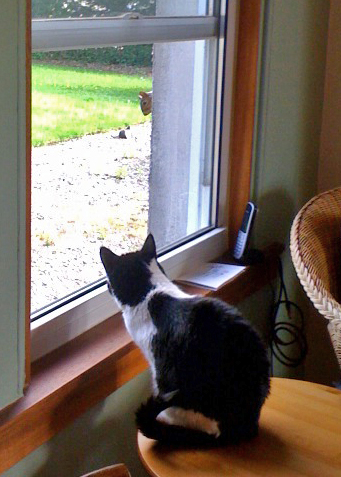
Meanwhile, as I courted the river, Molly befriended a squirrel. It’s not nearly as much fun as indoor mice, but it does add excitement to sunny quiet day.
 wonderful exchange