wind-rush, feather bright

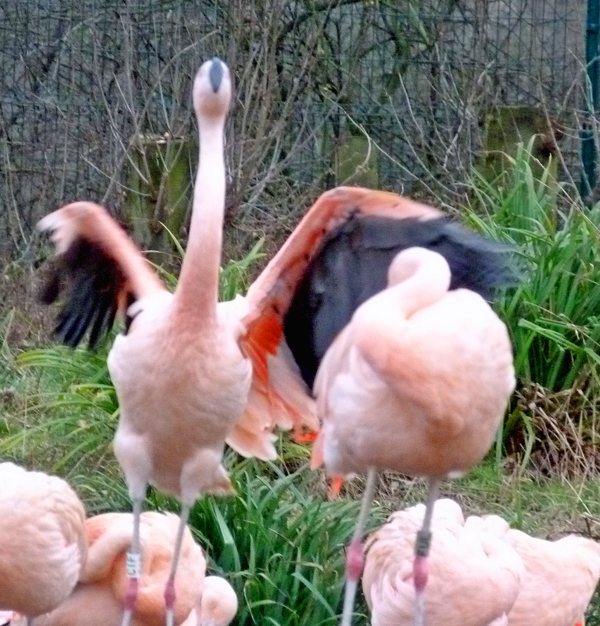
Today, the sun is shining, the cat is purring, and I’m off to visit the flamingoes.  In the absence of a pancake party, they seem to be the right companions for Mardi Gras.  There is a strange giddiness in the early spring.  All around the world is whispering, ‘hope, dream, dare.’

For many years, it was the solemnity of Lent that I loved — the very challenge of it, as I walked through the cold blustry days of an East Neuk winter, or the unending snow of a New England March.  I was fairly strict with myself then, keeping absolute fasts, carefully planning Lenten disciplines, finding it very hard to go to lectures or teach lessons on Ash Wednesday, never really relaxing till I was in church.

But it feels different now.  Either I have become lazier, or my sense of God has become more gracious.

Discipline is important.  I know how much difference it makes to pray in stable patterns:  early morning silence, daily office, Eucharist. And I know that to do that, other patterns must be stable too:  bed times and rising, meeting times and meals.  The rhythms of the day, the rhythms of the liturgical year — at times, a hassle; at times, lost in busyness or complexity, but ultimately–  a gift given to us for freedom.

When I set out on my jubilee year, it was a claiming of the freedom of the desert.  I was leaving my work behind.  I was leaving my patterns of life behind.  I left knowing — at last knowing — what had long been true:  that we can’t control what people think of us or say of us or make of our stories.  There are lots of times in life when truth and perception fail to meet, and we find ourselves alternately on both sides of that chasm.

I’m learning to live with that.  And that is a form a discipline too.

I want this Lent to be about freedom.  I’m hoping for a warm blustery March that will shake us all of our illusions and leave us laughing in the midst of God’s grace.  And I want that even in — especially in — those parts of our lives where pain remains, where new pains arise, where we cause and are caused harm, despite all our desires to the contrary.

And then, at Easter, I want kites.  Bright shards of joy, riding on the winds.

I should not write when I wake giddy and yearning for flamingoes.  It is sloppy and careless.  A messy Mardi Gras parade.  So be it.  Today is for feathered flurry.  Order and ashes tomorrow.
Lent Blog 2012

For the first time in several years, the Lent Blog is happening.

These seasonal blogs have been such a fascinating journey.  They began very firmly within the Scottish Episcopal Church, written by clergy and laity from across the province, and with an official fanfare on the SEC web page.   A lot of the contributors had never blogged before.  Some had never really written before.  I spent a lot of time teaching people to use WordPress and saying ‘of course you can…’

Over the years, I had to spend less and less time teaching WordPress.  Now I am quite cavalier about it.  I simply say ‘If you need help call. Otherwise, happy blogging.’

Both the readers and writers have changed, too.  I still think of Beauty from Chaos and Love Blooms Bright as a vaguely SEC blogs — but the truth is that several of us now live in England, we are no longer even vaguely ‘official’, and a lot of our readership comes from the States.  I love that the blogs find their own home.  This sort of organic sharing feels far more expressive of the Anglican Communion than any conceivable covenant.

But one thing has remained constant.  I still spend a lot of time saying ‘of course you can.’  There has not been a single season when we haven’t had a new blogger on board — someone who was not quite sure whether they should be doing this, or what they might have to say.  Because we are blessed with a few very loyal and highly skilled authors and artists who provide the ballast, it has always felt easy to take the risk.    Sometimes people join in and find that really blogging is not for them.  Other times, they take wing and soar.  And that is exciting.

This Lent, the blog will be produced by familiar voices from the Advent Blog, by old friends returning, and by those I would never have met were it not for the blogs.

As always, I find great hope in that.  I hope you will join us too at Beauty from Chaos.

music night (diaspora version)

You thought they’d stopped, didn’t you?  But we can do this at a distance.

Tonight’s song — guaranteed to lift gloomy moods, and banish all existential questions about uncontrollable futures — is an Alleluia, taught by Paul Vasile from the All Saints Company.

Vimeo and Firefox don’t always play nicely together, so if you are having trouble, go straight to the Vimeo site rather than trying to sing along here.

long shadows

What shapes a place?

Twenty-two years ago, St Andrews taught me that stones can breath and whisper, and town can have a life of its own. There are certain landscapes that tear open my defences, and leave me gasping in wonder. And there are other places that fill me with peace and calm — even if first they must shake me by the scruff of the neck to get my attention and force me past distractions and anxiety.

I am grateful for these places, and I return to them often.

But sometimes, I encounter a different sort of space that offers not grace, but disturbance. The negative emotions and anxieties that weigh down seem to come from outside me and bear no relation to my mood or prior expectations of the place. I find it disturbing, not only because the experience is unpleasant, but because I cannot explain it. I will happily suspend reason for wonder, joy and peace. But I struggle to suspend it for an unexpected darkness.

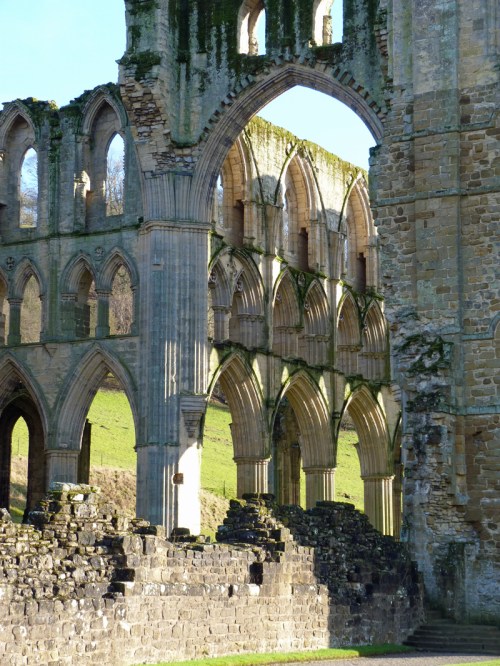
I went to Rievaulx expecting light. Realistically, I did not expect it could come close to the vibrancy of Fountains Abbey, but I hoped for a similar echo of holiness: the imprint of focused work and prayer. At first, I thought it was just that the light was too harsh, but the longer I stayed, the heavier I felt. Time and again, my eyes sought angles out, routes of escape, relief in the trees that found life beyond the walls. Fountains Abbey speaks to me of life. I sense a continuity with the past and can almost see the workman hammering the lead of the door hinge and the priest standing at the altar. In Rievaulx it was different. I felt trapped. I felt the death of the community, its fear, its destruction.

Of course, one can imagine these things; but there was no knowledge to feed my imagination, and no prior expectation. I had gone with a friend, and we hadn’t spoken much. We each walked around, experiencing it for ourselves, and it was only as we left that we realised we had both felt the oppression, were both eager to leave. We walked down the path, pondering it; and then suddenly, inexplicably, the atmosphere changed. I experienced it as a sudden intake of breath, a sense of release and freedom. My friend said it had felt like walking through a water-fall. Both of us were stopped mid-stride and mid-sentence by something we could neither see nor touch.

I do not know what happened at Rievaulx. Wikipedia tells of black death, and war, and the reduction of a once vibrant community to a remnant of 23 men. So I wonder: does the pain of that linger? Does fear echo through the stones?

I won’t forget Rievaulx, and I suspect it will creep inside my prayers. But I hope that I never have to go back. I hope, too, that whatever sorrow lingers there stays trapped in the stones, held back by that mysterious boundary line of water and breath and redemption.

There are more photos of Rievaulx on Life and Light