growth of an idea

Yesterday, we met for the weekly ‘No Small Talk’ pub lunch.  The topic was ‘what makes a good book for you’ — something easy to get us going again after the holidays.  My mental list read along the lines of:

  1. quality of writing
  2. quality of writing
  3. creativity
  4. quality of writing

But as I read last night, I realised I’d forgotten the one thing for which I will forgive a certain lack of verbal sparkle:  the ability of a book to generate and refine a thought stream.

It can be vague, of course:  half-thoughts that intrigue, but aren’t fully resolved.  And if the truth be told, I prefer the game when played not with written text, but in counterpoint with a good lecturer; but that is a more costly endeavour.  What I love is that moment when someone else’s idea leads you into something, a hunch, a glimmer — and then as you’re musing, and reading or listening to something which is their thought and not yours, they suddenly say something that gives you the next piece of the puzzle, that sets you off on a tangent again.

So, last night as I was reading Christopher Irvine’s The Art of God,  the thought stream went like this:

Picasso once said, ‘I don’t seek, I find’; the world is gratuitous, it is simply there, and there to be discovered and delighted in.’

interesting.  I would say I believe that.  It is an incarnational statement — the ability to God in our midst, to respond to what’s there, respectful of the other as other rather than as someone/ thing in relation to me.  But for all that it feels wrong.  I have a theology of incarnation, of givenness, but a seeker’s restlessness.  Not ‘as is’ but ‘becoming’ … more likely to seek than to find.  So how does that fit?

On and on it went, musing, pondering, following different themes and arguments being presented in the book, till 20 pages later, he said this:

The New Testament bears witness not only to the figure of Jesus Christ as the image of the invisible God, but also to how the Christian might grow into the likeness of Christ by being conformed to the pattern of Christ’s death and resurrection.

And there it is.  That’s why I spend half my days trying to offer the reassurance that God is already here, that we are already loved, that there is glory in our midst; and the other half trying to disturb the balance, to stir the cognitive dissonance needed for growth, to nudge people out of their comfort zone (and myself too) into the scary place where we are changed and changed again.

It’s not the best book ever — it feels a bit too much like a master’s thesis, covering old ground.   The writing is competent but not elegant.  It was stimulating without  being so captivating that my own lines of thought were overwhelmed; but sometimes ‘good enough’ is all you need.

[never what we hope for, but sometimes all we need]
storytime

So, do we suppose I am enjoying my bedtime reading, or just enjoying the thought of enjoying it?  Sadly, it’s acted more like espresso than chamomile.

The idol does not indicate, any more than the icon, a particular being or even class of beings.  Icon and Idol indicate a manner of being for beings, or at least for some of them.  Indeed, a determination that would limit itself to opposing the ‘true God’ (icon) to the ‘false god’ (idol) in extending the polemic of the vetero-testamentary prophets, would not be suitable here.  For the Christian iconoclasts of the eighth century gave the name ‘idol’ to that which had been conceived and venerated as icon of the true God, and the Jews of the Old Covenant rejected all representation as idolatrous, even representation of the God of the Covenant.  (the ‘Golden Calf’, it has been argued, perhaps only personalized the God of the Covenant, and the very Temple of Jerusalem could have been deserted by the divine Shekinah only insofar as it foundered in idolatry.) …  In short, the icon and the idol are not at all determined as beings against other beings, since the same beings (statues, names, etc.) can pass from one rank to the other.  The icon and the idol determine two manners of being for beings, not two classes of beings.

Jean-Luc Marion, God Without Being
transl. Thomas A. Carlson

You must admit, that bit about the Skekinah is pretty clever.

the land of Lemsips

This is just a quick note to say I am still alive.

Coughing and hiding under blankets, but still here.  Those of you who read Ruth’s blog will know she turned her recent illness into a book festival.  Hoping to do the same for part of today and tomorrow, though there is also great need to wade through the props that remain from the Michaelmas event and the suitcases that haven’t been unpacked.

Still, it’s not all bad.  The vestry got an unexpected night off last night, which I hope they enjoyed; and Molly was so blissfully asleep on my lap that she nearly fell off.

Now, what shall I read?  I’ve read Dave Walker’s recent My Pew: things I have seen from it, and the related What I am doing here?, a beginners guide to church (well worth a look).   I think liturgy next, then a book on transitions.  If I make it all the way to systematics, you will know I am feeling better.

ex libris

books

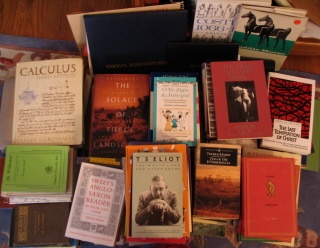
The culling of books has begun.

The trouble with being a dabbler is that I keep hoping to turn back to things to study them (or remember them) properly one day. So, given the task of choosing which of my State-side books to keep, I have a riduculous pile of things that includes books on several languages I can’t speak, costumes I will never make again, equations that eluded me at the best of times, horses that barely exist in Britain, as well as the more sensible novels, poems, books of theology and childhood favorites. Oh, and a few on cognitive development and curriculum planning since they do come in handy.

Sheer and utter madness.

Some people have photo albums. I have a library.