What shapes a place?
Twenty-two years ago, St Andrews taught me that stones can breath and whisper, and town can have a life of its own. There are certain landscapes that tear open my defences, and leave me gasping in wonder. And there are other places that fill me with peace and calm — even if first they must shake me by the scruff of the neck to get my attention and force me past distractions and anxiety.
I am grateful for these places, and I return to them often.
But sometimes, I encounter a different sort of space that offers not grace, but disturbance. The negative emotions and anxieties that weigh down seem to come from outside me and bear no relation to my mood or prior expectations of the place. I find it disturbing, not only because the experience is unpleasant, but because I cannot explain it. I will happily suspend reason for wonder, joy and peace. But I struggle to suspend it for an unexpected darkness.
I went to Rievaulx expecting light. Realistically, I did not expect it could come close to the vibrancy of Fountains Abbey, but I hoped for a similar echo of holiness: the imprint of focused work and prayer. At first, I thought it was just that the light was too harsh, but the longer I stayed, the heavier I felt. Time and again, my eyes sought angles out, routes of escape, relief in the trees that found life beyond the walls. Fountains Abbey speaks to me of life. I sense a continuity with the past and can almost see the workman hammering the lead of the door hinge and the priest standing at the altar. In Rievaulx it was different. I felt trapped. I felt the death of the community, its fear, its destruction.
Of course, one can imagine these things; but there was no knowledge to feed my imagination, and no prior expectation. I had gone with a friend, and we hadn’t spoken much. We each walked around, experiencing it for ourselves, and it was only as we left that we realised we had both felt the oppression, were both eager to leave. We walked down the path, pondering it; and then suddenly, inexplicably, the atmosphere changed. I experienced it as a sudden intake of breath, a sense of release and freedom. My friend said it had felt like walking through a water-fall. Both of us were stopped mid-stride and mid-sentence by something we could neither see nor touch.
I do not know what happened at Rievaulx. Wikipedia tells of black death, and war, and the reduction of a once vibrant community to a remnant of 23 men. So I wonder: does the pain of that linger? Does fear echo through the stones?
I won’t forget Rievaulx, and I suspect it will creep inside my prayers. But I hope that I never have to go back. I hope, too, that whatever sorrow lingers there stays trapped in the stones, held back by that mysterious boundary line of water and breath and redemption.
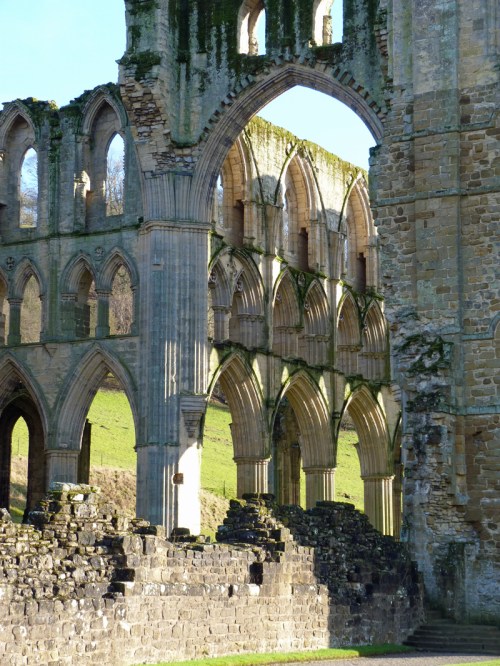
There are more photos of Rievaulx on Life and Light
 wonderful exchange