res miranda

Gosh, it’s been a long time since we’ve had a good blog discussion.  The comments on the last post on the Easby Nativity are wonderful — and I still haven’t thought through half of them.  Kelvin seems to be leaning towards an essay on the influence of Eastern thought on Marian iconography.  Rosemary is exploring the economic situation of the holy family and the scarcity of donkeys.  Meanwhile Ruth keeps us grounded.
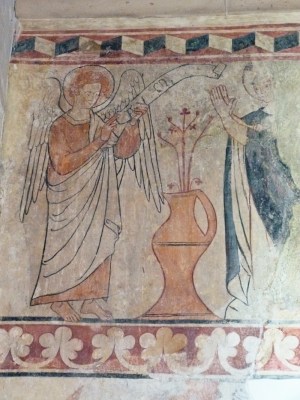
Inevitably, the essay I had in mind was about the incarnation and eucharistic theology (when is it not?).  The detail that fascinates me most in the mural is the hint of writing that threatens to cover the scene.  Other, now absent, writing did more damage to the Annunciation, and I wonder if the Reformers who whitewashed the murals used extra-nasty wash on the Marian scenes to try to ensure her demise.  Thankfully Mary is too tenacious for that, and we love her for it.

So, I find that these pictures help me understand the pain and turmoil of the Reformation in a way I never really have.  I’m no good at history, and care little whether something is in English or Latin, so the word-driven conflicts feel remote to me.  But when I stand in front of the Easby murals and think of them being blotted out and then covered with heavy words, I sense the anger of the masses who must have wanted their plucky Mary and weary Joseph back.

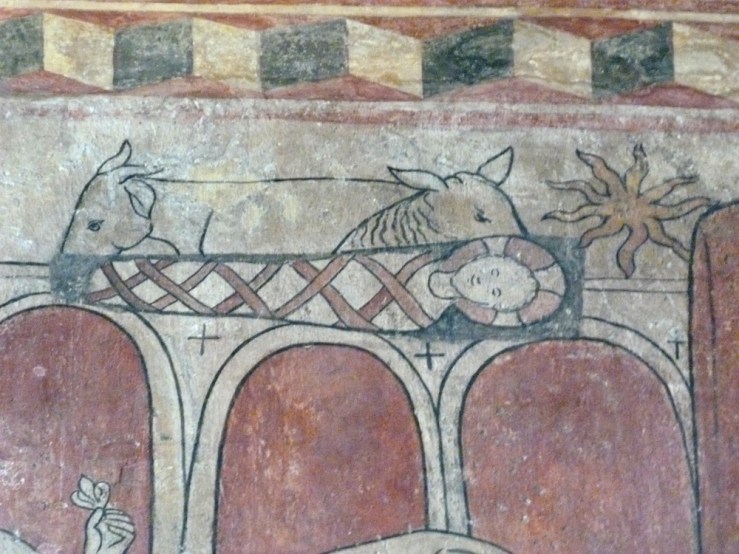
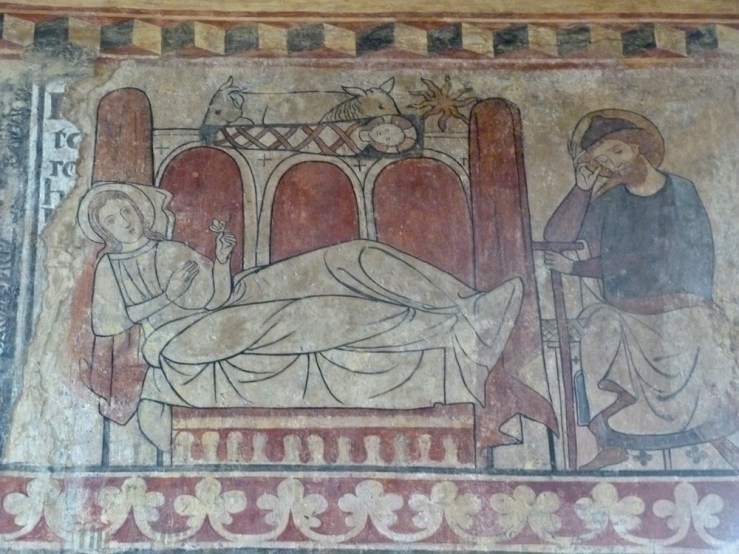
I wonder, too, how the paintings effected the congregation’s experience of the eucharist.  If every time you take bread and wine, the Christ child is smiling down at you from his ox-warmed crib, do you experience the paradox of Word made flesh, bread made flesh, flesh made Word more deeply?  Does it lead to a gentler, more hospitable Christianity than if you break bread and wine under the ominous Gothic script of The Law?  For me it would.

And for all that one might criticize the hierarchies of the Mediaeval church, I think there is something much more open-ended in telling the story of salvation through pictures instead of words.  Pictures tug at our hearts.  Quotations tell us that someone thinks they know just which bit of God’s word we most need to hear.

So, in the Curriculum of Wonder?  Well, this picture would keep us busy for a long time.  With younger children, we’d spend a few weeks with it at least (looking, naming what we saw, asking questions, learning songs, drawing pictures, imagining how it felt to see them covered over, trying to understand why someone would think it was right to do that, wondering how we can cope with people who upset us deeply).  With older teens, it might take a term, or a year.  I can imagine people picking a detail and trying to make sense of it; learning the history, exploring other images, talking with people about their sense of the nativity or the eucharist or the use of pictures in worship today.  And it seems to me that this is how we think now anyway — following links, exploring chains of ideas, letting something catch our eye and seeing where it leads us.   And then the teaching comes in trying to help each person put all the pieces together: to find some sort of cohesion and meaning in the midst of all the possibilities of wonder.  Teaching probably isn’t the right word.  It’s more ‘focusing’ — holding someone still long enough that they have time and space to think, and not letting them off the hook till they do.

Each panel of the mural tells a different story — it offers a different, overlapping curriculum.  I’m about to post them all up on Life and Light.  And today I give thanks for the vision of the artists who first pictured the smiling Christ-child, the brave Mary, the star-struck shepherds, and the insistent angels.  I am glad they got in quick with their water-colours before the plaster dried, and thus left us with visions of the glory of God that endured the worst of churchy conflicts and self-righteous violence.
turning point

The best exam question I was ever asked came at Christmas in my sixth form year.  It was in a British Studies class: in interdisciplinary History and Literature class, team taught by two of the best teachers I have ever had. It was my first three hour exam:  an hour for literature, an hour for history, and an hour for… well, that’s the bit I want to tell you about.

The third hour was a free for all.  In the last minutes of the second hour, the teachers began placing postcards face down on our desk.  The postcards had something to do with the curriculum, and it was our task to figure out and write about what.  That was all.  ‘Please write for one hour in reference to your postcard and the things you have learned this term.’

Mine was of a boar snuffling around the base of a tree.  At least I think it was a boar.  It might have been a pig, but it was hard to tell. It was richly coloured and glinting, from some illuminated manuscript or other.  Quite lovely, in its way, but a bit alarming as an exam question.

I paused briefly to panic, and watched as every illuminated boar-related though flit through my mind.

  • truffles
  • manuscript
  • monasteries
  • scribes, literacy
  • court
  • hunting
  • poverty and riches
  • Grendel
    (no, I don’t know why either, but it works like that sometimes)
  • Boar’s Head Carol
  • Boar hunting >> dangerous >> knights>> chivalry
  • heir to the throne, risk
  • oh help, I need to write an essay about a boar?
  • England and France
  • Aquitaine
  • The Lion in Winter
    No, wait.  That’s a different course.
  • Oh help.
  • Bestiaries

Anyway, you get the idea.  There is actually more than enough there to write for an hour.  You just need to sort it into clusters and wax lyrical.  I took a deep breath, and wrote frantically till the time was up.

And then I panicked all through the holidays because I really hadn’t a clue as to what they had wanted or whether I had given it to them.

Thankfully, I had.  It was a turning point for me:  the first moment my terribly divergent mind was given free reign and deemed worthy.  It was fun.  And, I confess, all the more so because most of my classmates — who were usually smarter and faster and more clever than I– had not coped with the postcards at all and suddenly, my essay was offered up as the model.

I was reminded of that exam as I looked at the wall paintings in Easby recently.  Easby is best know for the Abbey ruins, and the Turner painting thereof.  But what I didn’t realise for years was that the real treasure of Easby is in the parish church.   There, unguarded and unprotected, are a set of wall paintings dating from  c. 1250 which tell the story of salvation.

They are captivating and beautiful, and I will say more about them later in relation to my nascent thoughts on wonder. But for now, I just want to show you my favourite and ask you to consider in in the spirit of the British Studies exam.

once a piskie?

This week I am posed with a question that was bound to arise eventually: am I still a Scottish Episcopalian?

Clearly, I am not living in Scotland, and I am not currently a member of an SEC congregation; which might be a strike against.  But there was another time when I lived in England for two years — in the edge-less Midlands– and there was no doubt in my mind that I was a piskie then.

Indeed, that is when vocation stirred, and I had to engage in the repeated explanations of why I was an Episcopalian living in England, called to be ordained in Scotland, rather than a lay-chaplain in England called from within local structures. That was easier than it might sound, really.  I had no trouble at all persuading people that I was piskie, not C of E.

And therein lies the rub.  For I worship in the C of E right now.  Variously.  In big churches and small, in one diocese or another; and I thank God for the cavernous space of the Cathedral that calls me back and back again to offer a sacramental home and no shortage of back doors. But I am not C of E.  I fear I am too American to ever be C of E.  Separation of church and state is deep within my bones, and I never could understand why anyone would add the word anti- to disestablishmentarianism unless it achieved a Triple Word Score.

‘Not’, however, does not define ‘is’.  Being a piskie is more than not being C of E.  And that too was part of my sense of call:  to a whole church; to a brave church that was reaching towards the future; to a church that was small enough that it dare not waste anyone’s talents, and intimate enough to learn what each person might be able to offer.  That was the dream, anyway.  The reality was sometimes harder.

So, I guess the question ‘am I still a piskie’ is really a question of whether enough of the dream remains.

Two things happened this week to show me that it probably does.

First: I was not at all surprised but terribly disappointed by the offical SEC response to the Consultation on Marriage.   Not surprised, because it was the church doing what it does best:  dancing around an issue, careful to say nothing and to say it on good precedent, trying to ensure that nothing could cause offence.  Disappointed because, while that is a church I recognize, it is not a church I believe in or dream of or long to be a part of.  We used to be braver than that.  I want us to be braver again.

Today I was reading Hilary Clinton’s UN speech on LGBT rights.  In it she says this:

Leadership, by definition, means being out in front of your people when it is called for. It means standing up for the dignity of all your citizens and persuading your people to do the same. It also means ensuring that all citizens are treated as equals under your laws

It’s worth reading or listening to the speech in full, as she also speaks well of how ‘rarely are cultural and religious traditions and teachings actually in conflict with the protection of human rights’. Clinton named for me the shape of my disappointment in the SEC’s official response to the Equal Marriage legislation in Scotland.  I know that the church is not of one voice.  I understand that most people in most congregations probably spend very little time deciding what they think about equal marriage legislation, and that it is the marginal voices (liberal and conservative, both) that push this issue.  But sometimes, the church needs to get out ahead of the majority and do what is right and just and true.  Sometimes, the church should lead.

So, I was frustrated.  And that is a good sign.  It means I still care enough to be frustrated.

Secondly, though, I was proud:  proud of the vestry of St Mary’s Cathedral in Glasgow, who let neither difference of opinion nor caution from the central church structures daunt them.  Theirs is the response I wish the whole church had made.  Theirs is the vision I recognize and want to be a part of.  Indeed, that is the understanding of the church I was formed in and was called to.  It is good to know they are there.

I suspect I am still a piskie, and always will be.  It’s just that sometimes, that’s a rather hard thing to be.

bloggy blessings

I am quite good at being a recluse.  I enjoy it.  And I have never indulged in it as thoroughly as I have over the last few months.

When I get enough time to be a recluse, then eventually I have enough energy to make time for my friends.  I know:  some of the people I care most about have still been dreadfully ignored, and oh-so-patient-and-understanding while I’ve gone quiet.  But others have re-emerged.  Friends from the States.  Friends from other parts of my life, who long endured the silence borne of an over-full diary and silly stress levels.  We have begun writing again.  And speaking.  And I have been amazed at how quickly friendship resumes, how deeply is it imprinted despite long neglect.

And finally, it seems, I have the energy to re-engage with some of what I left behind this summer.  Once upon a time, if I had disappeared from the SEC to watch kingfishers and bake cakes in Durham, that might have been the end of it.  No way back.  In Exile in Englandshire.  But the blogs change all that — even when my own blog is largely dormant.

For five years now, I’ve been nudging seasonal blogs into being:  Love Blooms Bright in Advent, and Beauty from Chaos in Lent.  Some of our readers didn’t know my life had changed, and asked if the blog was going on.  So, the blog that began in hopes of reaching people on the margins finally came back to catch me.

Dusting off a seasonal blog takes long than you might think.  It takes longer than I think, though I’ve done it so many times.  But still one needs to gather the team, encourage new bloggers, stir ideas with those who have written so often that all the obvious things have been done. The site needs updating, the Creative Cmomon’s license needs renewing, and of course the blog needs a twitter account of its own (@LvBloomsBright).  Indeed, I need a twitter account of my own (@wonderfulexchng) since my old one was tied to my previous location.   So, all afternoon there has been the familiar twooo of the tweet deck.  A few weeks ago it would have felt invasive and annoying, but today it has been fun.

I guess that means I’m re-emerging — though I suspect there’s a bit of the hokey-pokey about it.

And then, in a perfectly timed moment of encouragement, Mother ruth called me by name.

I’m looking forward to Advent, and so glad for the healing, redeeming round of the church year.