long shadows

What shapes a place?

Twenty-two years ago, St Andrews taught me that stones can breath and whisper, and town can have a life of its own. There are certain landscapes that tear open my defences, and leave me gasping in wonder. And there are other places that fill me with peace and calm — even if first they must shake me by the scruff of the neck to get my attention and force me past distractions and anxiety.

I am grateful for these places, and I return to them often.

But sometimes, I encounter a different sort of space that offers not grace, but disturbance. The negative emotions and anxieties that weigh down seem to come from outside me and bear no relation to my mood or prior expectations of the place. I find it disturbing, not only because the experience is unpleasant, but because I cannot explain it. I will happily suspend reason for wonder, joy and peace. But I struggle to suspend it for an unexpected darkness.

I went to Rievaulx expecting light. Realistically, I did not expect it could come close to the vibrancy of Fountains Abbey, but I hoped for a similar echo of holiness: the imprint of focused work and prayer. At first, I thought it was just that the light was too harsh, but the longer I stayed, the heavier I felt. Time and again, my eyes sought angles out, routes of escape, relief in the trees that found life beyond the walls. Fountains Abbey speaks to me of life. I sense a continuity with the past and can almost see the workman hammering the lead of the door hinge and the priest standing at the altar. In Rievaulx it was different. I felt trapped. I felt the death of the community, its fear, its destruction.

Of course, one can imagine these things; but there was no knowledge to feed my imagination, and no prior expectation. I had gone with a friend, and we hadn’t spoken much. We each walked around, experiencing it for ourselves, and it was only as we left that we realised we had both felt the oppression, were both eager to leave. We walked down the path, pondering it; and then suddenly, inexplicably, the atmosphere changed. I experienced it as a sudden intake of breath, a sense of release and freedom. My friend said it had felt like walking through a water-fall. Both of us were stopped mid-stride and mid-sentence by something we could neither see nor touch.

I do not know what happened at Rievaulx. Wikipedia tells of black death, and war, and the reduction of a once vibrant community to a remnant of 23 men. So I wonder: does the pain of that linger? Does fear echo through the stones?

I won’t forget Rievaulx, and I suspect it will creep inside my prayers. But I hope that I never have to go back. I hope, too, that whatever sorrow lingers there stays trapped in the stones, held back by that mysterious boundary line of water and breath and redemption.
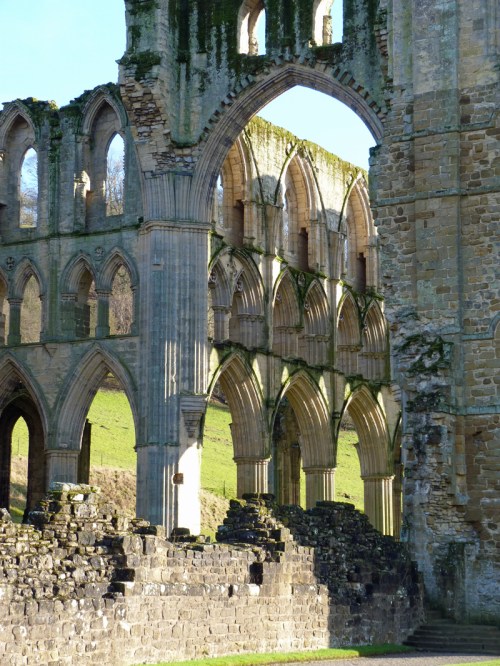
There are more photos of Rievaulx on Life and Light

voicing

I caught the cathedral purring today.  Bright sun filtering through the clerestory onto the ceiling vault.  Vergers on benches or leaning against pillars, at ease among the tiny handful of visitors.  I love it like this; a gift of unmerited grace.

Then, the voicing of the organ began: a long low note from the south transept.   Voicing fascinates me, though I know nothing but what one gleans from hearing it done.  The note begins fuzzy and rumbly and is allowed to fill the space.  Then — slowly, miraculously–  it is gathered in.  The fuzziness stops.  The note rings true, and the building sighs in response.

Pipe after pipe, note after note, it is the same: each drawn into its own centre, then taught to resonate with the others.

It seems like a perfect expression of both church and prayer.  One note at a time, prayer turns the volume up on our fuzziness, till the true note sounds and we are gathered in.

It’s a slow process though.  Slower for people than organs.  In the time I was there, Jophiel and the organ tuners managed three pipes.  God and I were content with just one.

unexpected song

I stood where I always stand, in the centre of the nave.

There’s a spot — two-thirds of the way back — where the building offers itself whole. The nave stretches out in front of you:  altar, crossing, rood screen, high altar.   You can see just enough of the tower that it seems to rise forever into the light.  And you can sense– rather than see– the breadth of the transepts and the chapter house misbehaving in the corner.

I love the simplicity of it.  The complexity of it.  The perfection of scale ( all the more endearing for the oddities of the rood screen).

I stood for a long time, letting the stones still me.  Accepting that they had, in fact,  faced far worse atrocities than the current entry system.  I stood till all was calm and I had found myself again in proportion.

And then the building began to hum.

I have spent many hours in York Minster.  More that you might think, given that I’ve never lived anywhere near.  I have prayed quietly and joined in large congregations.  I’ve heard concerts, crowds, and construction.  But never anything like this.

I could feel the wind through the open West Door.  Maybe that was it?  Some odd coincidence of open doors and atmospheric pressure, turning the nave into song.

Then I though it was perhaps one of the bells, sent vibrating by a similar confluence of wind and  movement, buzzing in sympathy with a struck stone.

I wondered if it were angels, archangels, and the whole company of heaven (bass section).  And even thought that it could be the same sort of vibration that starts a bridge swinging, bouncing, snap.

If the building was about to rearrange itself, the experience would be worth the risk.

So I stood still.

In time, I began to realize that the sound was the echo of a drum.  African drums, it seemed (perhaps something in the crypt or naughty chapter house?)  And as soon as I had decided on the truth of that I heard a cry — a song of sorts– the sound of a voice, carried across the plains, that speaks to some deep ancestor in all of us (reinforced no doubt by modern recordings from Africa and Hollywood laments of Indian Chiefs).

The thing is:  it felt so right.

The building knew it was right.  At last, a song that was big enough to honour the stones.  A song that was wild enough to echo the yearning.  The spaciousness of God in reflection, held and filled and free.

I stood for a long time, dwelling somewhere above the crossing.  Then when yearning turned to peace, I came down to the cross that was by then alight on the altar.

Eyes can do funny things in the midst of the spaciousness of God.  But words are not as clever, so you will just have to take that on faith.

I eventually did move.

And I learned what had set the building humming.

But that’s enough for now.  I’ll tell you the rest tomorrow.

different ways

We’ve been having conversations, lately, about different ways of caring about people.  My way is this:

I stand in the rain, leaning against the east wall of the church, where I can watch the porch door without being seen.  It was time to lock up, and now it is not, because inside someone is praying.

10 minutes.
20 minutes.
30 minutes. raining.

Someone else?

someone else would have gone in and chatted with him and learned his life story and invited him to church.

and there is never any way to be sure which is best.

but my way is to stand in the rain, waiting.

trusting God in silence.