just wondering

I’ve had a few conversations this week that have left me wondering what sort of ‘teaching’ usually goes on in church.

So, this is by way of a survey for anyone willing to answer:

1. Where did you (/do you) learn about prayer? If it was not through the ‘normal’ life of your church, have you ever received teaching on prayer in your congregation?

2. What shapes your understanding of scripture? Does your experience of church lead you to believe that there is one way to read scripture or many ways?

3. Have you ever had a chance to talk with others in your church about your understanding of (and your potential difficulties with) central aspects of faith (e.g. — love, forgiveness, resurrection, redemption, judgment…)?  If so, how did the conversation come about?

If you know of people who might be willing to answer but who don’t usually read this blog, please invite them into the conversation. I’d really like to know what people from different backgrounds have experienced.

for as the rain…

This is not quite the ‘theology’ blog a couple of you have asked for, but is almost that — on prayer.

I spend a lot of time in prayer not sure of what is going on. Nothing unusual in that, of course. But it can still be frustrating. Not least when you are trying to pray with a text for a particular reason: because someone has suggested it to you, because some instinct says it is what is needed, even because that is what the lectionary offers on a given day.

But here’s the thing. When I am standing by the water in tall grass… when the difficult question I’ve been avoiding finally forms directly and cannot be shirked… when the ‘answer’ comes as fast as the oyster-catcher turns on the wing… then the ‘answer’ comes as the memory of prayer, as a text that wouldn’t bend under my will, that wouldn’t yield what I wanted. Until it (or I?) was ready.

a mighty defender

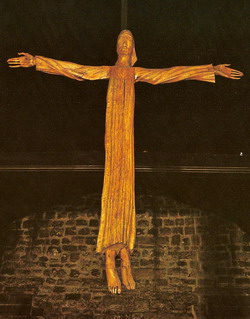
jarrow ascensionA week off always leads to the question: where shall I pray? Somehow, I never quite settle to pray in other people’s houses, so I make half-hearted attempts for several days running, then go hunting for a nice quiet church somewhere.

Or in this case, a not so quiet church, and an even less quiet Cathedral.

I have never been overly impressed with Durham Cathedral’s arrangements for quiet prayer. To guarantee privacy and to pray with the reserved sacrament, one must overlook large Mother’s Union banners and irksome gaps on either side of the altar which offer a view of all the tourists walking by. But despite all that, it is a place I return to, a place where things often ‘happen’ in prayer.

But not this time. The chapel was blocked off so that they could varnish pews in the adjoining transcept. OK. One must varnish pews somewhere. But where to pray? I asked a verger if alternate arrangements had been made. ‘No, I don’t think so. Can’t you get in at all? Oh well. It’s not to be.’

Not dissuaded, I tried again. I asked the head verger and the flock clustering round the welcome desk, ‘is there a quiet place to pray — the usual chapel is blocked off?’

‘No, I don’t think so.’

‘Nowhere at all? Do you know how long the chapel will be blocked?’

‘No idea. A good while, I should think.’

‘And no other space has been set aside?’

(at this point, the flock joined in) ‘Did you try Bede’s chapel?’ (‘you mean the one with the school group in it?’) ‘Did you try the Galilee Chapel?’ (‘the one they are cleaning?’) ‘Look, there’s an empty pew’. (surrounded on all sides by tour groups and cameras). So I gave up and stood by the river in the rain.

Next day: Ascension. I got my timings wrong and missed the morning service at the cathedral in Newcastle, so in the afternoon I went to Jarrow. The nave of St Paul’s dates from the 7th century and manages to retain its holy hush no matter what the modern pilgrims do.

But just as I got there, I saw the film crew drive up: autocue, cameras, the works. It did not bode well…

I scurried in quick, straight to the head verger. ‘Is something going on this afternoon? I was hoping to pray, but I’ve just seen a film crew…’

‘Oh don’t worry about them, pet. I’ll keep them at bay. You just go into the sanctuary, and I’ll deal with them till you’re done.’

And so he did. Blessed man.

Bede would have been proud.



colour prayer

colour prayerDuring Lent, a small group from Dunoon has been exploring different methods of prayer. Many of our sesions have involved led meditatations: everthing from tools for developing our attention to meditations on scripture and imaginative prayer. None of it has translated well into blogging. But tonight’s session might. We were considering ways of using colour in prayer.

The basic idea is this: colour often carries emotional content. Sometimes, when we would be hard-pressed to name how we are feeling, we find we can colour it quite easily. By paying attention to what we are feeling, and being honest with ourselves and with God, we can learn to be ‘real’ in God’s presence.

Colour prayer takes lots of forms. It can be as simple as scribbling on the corner of a page — trusting that God is present, trying to be open to what we are feeling. We might use only one colour, or we might form something quite elaborate. The shape that emerges might be important, or the ‘truth’ of the picture may rest solely in the balence of colour. We often won’t know what we are doing, or what it might mean till long after we’re done.

The picture at the top is a colour sqare. It is a way of reviewing the day or working through a specific issue or relationship. You begin by assinging colours to a range of emotions: hope, fear, anxiety, anger, love, trust… You also assign a God colour. Then you look back at your day (or the situation that’s on your mind) and begin colouring. How have you felt today? Fill the square in however it seems best.

Often people find that the process surprises them. There is more anger than they had realised, or more hope, or more joy… As the drawing is nearing its natural end, look for your God colour. It is there already? If not, where might it go? Or is it hidden today? Don’t assume there is a right answer — just be aware your perceptions.

When you finish colouring, take a minute to pray verbally or simply sit in God’s presece, then draw the prayer time to a close.

Sometimes the ‘meaning’ of a colour sqaure or free-draw will be obvious to you. Other times, it may not. It may be that it is only when you look back at several drawings together that patterns begin to make sense.

I find that praying with colour is particarly helpful when emotions are running high. It’s a way of getting them out, seeing what they look like, dealing with them. You can also pray through scripture or theology this way. What would the last supper look like? Or forgiveness? Or resurrection?

Enough. Molly has just arrived to say that happiness looks like brown bits on a white plate, followed by an endless expanse of ivory duvet (and crossness is the sudden surge of red after the swipe of pearly claw).