 During Lent, a small group from Dunoon has been exploring different methods of prayer. Many of our sesions have involved led meditatations: everthing from tools for developing our attention to meditations on scripture and imaginative prayer. None of it has translated well into blogging. But tonight’s session might. We were considering ways of using colour in prayer.
The basic idea is this: colour often carries emotional content. Sometimes, when we would be hard-pressed to name how we are feeling, we find we can colour it quite easily. By paying attention to what we are feeling, and being honest with ourselves and with God, we can learn to be ‘real’ in God’s presence.
Colour prayer takes lots of forms. It can be as simple as scribbling on the corner of a page — trusting that God is present, trying to be open to what we are feeling. We might use only one colour, or we might form something quite elaborate. The shape that emerges might be important, or the ‘truth’ of the picture may rest solely in the balence of colour. We often won’t know what we are doing, or what it might mean till long after we’re done.
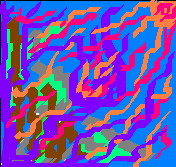
The picture at the top is a colour sqare. It is a way of reviewing the day or working through a specific issue or relationship. You begin by assinging colours to a range of emotions: hope, fear, anxiety, anger, love, trust… You also assign a God colour. Then you look back at your day (or the situation that’s on your mind) and begin colouring. How have you felt today? Fill the square in however it seems best.
Often people find that the process surprises them. There is more anger than they had realised, or more hope, or more joy… As the drawing is nearing its natural end, look for your God colour. It is there already? If not, where might it go? Or is it hidden today? Don’t assume there is a right answer — just be aware your perceptions.
When you finish colouring, take a minute to pray verbally or simply sit in God’s presece, then draw the prayer time to a close.
Sometimes the ‘meaning’ of a colour sqaure or free-draw will be obvious to you. Other times, it may not. It may be that it is only when you look back at several drawings together that patterns begin to make sense.
I find that praying with colour is particarly helpful when emotions are running high. It’s a way of getting them out, seeing what they look like, dealing with them. You can also pray through scripture or theology this way. What would the last supper look like? Or forgiveness? Or resurrection?
Enough. Molly has just arrived to say that happiness looks like brown bits on a white plate, followed by an endless expanse of ivory duvet (and crossness is the sudden surge of red after the swipe of pearly claw).
 wonderful exchange